
Why I Chase Beauty for a Living
On being a landscape photographer
Scroll to explore
I get to be in the most beautiful places, at the most beautiful times, in the most beautiful conditions I can plan for. That's my job. I chase beauty for a living.
It sounds romantic when I say it like that. And it kind of is. But it's also early alarms and frozen fingers and hiking for hours with everything you need to survive on your back. It's planning obsessively, checking weather models, studying angles, working out where the light will fall and whether you can physically get there in time.
It's work. Hard work. But I wouldn't have it any other way.
Where It Started
I didn't set out to do this. I had a corporate career, a sensible job. But something shifted on my first big multi-day hike, the Overland Track in Tasmania. I'd bought all the gear, convinced I'd bitten off more than I could chew.
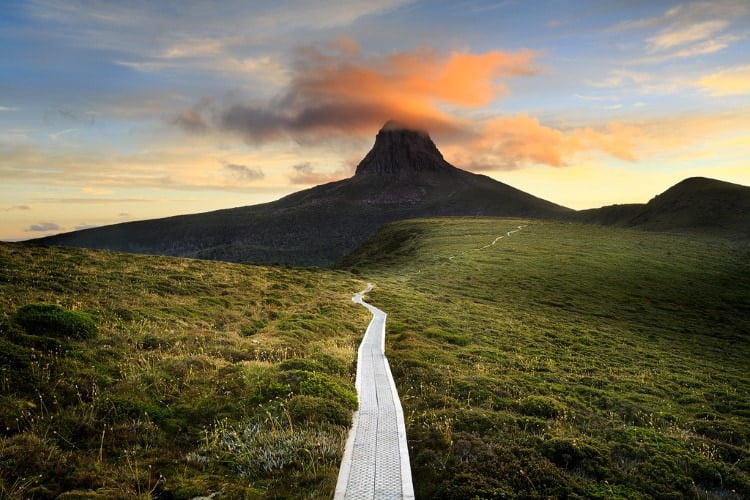
Then, on Cradle Cirque, I had a sunset that changed everything. This cloud lit up over Barn Bluff in a way I'd never seen before. I was photographing on my own, and it was just still and calm, and for the first time I understood what being out in the wilderness is actually about. You're vulnerable, but you're more alive than you've ever been. The wilderness is completely oblivious to you, to society, to everything. It just does what it's always done.
I knew I had to experience more of it. Explore more. See more. Photograph more. That was the start.

Planning
There's a lot that needs to happen before you leave home. What's the weather doing, what's the aurora forecast, what are the tides, where will the sun rise, how long to walk in, how many days will it take, do I have all the gear I need, am I capable enough of getting there, who am I going with, where can I get water. And then on top of all that practical stuff, you've still got to carry your camera gear. Photographers always have a weight penalty, two or three kilos at least. I normally take two or three lenses, a tripod, sometimes two tripods if I think conditions might call for it.
But before any of that, I need to have something in my mind's eye. A vision. A dream shot, I often call it. Some kind of image I'd like to create that's pulling me along the track. I'm a photographer that bushwalks, so I need that vision to motivate myself through the hardship. It doesn't have to be the shot I end up getting, and often it isn't, but I do need something to get me out the door. One shot in my head is usually enough.


Journeys
If you want to reach the really special places, the remote wilderness spots that feel almost sacred, the car park is just the beginning. Some places are days of hiking from the trailhead. This is where you earn it. You've got to work hard for it in Tasmania.
The seven-day hikes. The thousands of kilometres driven. The tenth pair of hiking boots. Knee-deep mud. Blisters. Being so tired at the tripod you can barely keep your eyes open. I've fallen asleep waiting for the light more times than I'd like to admit. The early mornings when you haven't slept enough but you get up anyway because the light won't wait. You think about all the effort you've put in to be there, and if you don't get up, what was the point? All of that for two minutes of light. But those two minutes are everything. That's the moment.
The hardest thing about landscape photography is getting out of bed.
Ken Duncan
After a week out in the bush, you become part of the landscape in a way. The dirt's all over you. You're pushing through scrub and it's on your clothes, under your nails. You're in it. And the camera's there with you.
I remember a seven-day trip to the Western Arthurs where my boot started falling apart on the first day. At the trailhead I had a new pair and an old pair in the car, and for some reason I chose the old ones. You spend all this time meticulously packing, weighing your bag to the gram, and then at the last minute you make a snap decision that changes everything. A tiny hole formed near my toe and just kept getting worse. By day three it was the biggest problem of the whole trip. I'd forgotten duct tape, so I was trying to patch it with my Therm-a-Rest repair kit, gluing bits back together, constantly worrying whether it would hold for another day. A silly decision at the car park, and suddenly you're wondering if you'll have to turn around and limp out with a mangled boot. It held together until the end, just. The old boots got one last adventure. Barely.
You kind of just have to adapt and push through. The photos don't take themselves.
The Camera as Permission
People sometimes say they wouldn't bring a camera because they want to enjoy the moment. I understand the sentiment, but for me it's the opposite. The camera is what gives me permission to be there.
Without it, would I really stand in one spot for three hours waiting for the light to change? Would I climb to a peak just to watch the sky? Maybe some people do. But the camera gives me a reason to sit with a landscape in a way most people simply wouldn't. Day after day, visit after visit, you develop this deep connection with a place because you're really watching it. Observing it. Reading it in a detail that people who aren't doing this might never understand.
And the more proficient you get, you stop thinking about the camera and start reacting to the scene. You're not fiddling with settings and then looking at the landscape. You're doing both at once. You fall away and it's just you and the light and the scene unfolding.
When you go out there, you don't get away from it all, you get back to it all. You come home to what's important. You come home to yourself.
Peter Dombrovskis

Moments
This is what gets you up early even when you're exhausted. All that planning, all that effort, all that waiting. It comes down to one or two minutes when the light is there.
I think of a trip towards Federation Peak. I decided to walk in via Arthur Plains and up Luckman's Lead, and it turned out to be one of the hardest days of hiking I can remember in Tasmania because it was the hottest day of the year. I was carrying a very heavy pack with multiple cameras and lenses to give me different photographic options. Seeing as I'm putting that effort in to get there, I might as well have the right gear for the job.
I only just made it to the top of the Dial in the Eastern Arthurs near Stuart Saddle Camp for sunset. I was already really tired, so after shooting through sunset and waiting for the skies to darken, the aurora showed and I managed to get a few shots. Because the conditions were calm and clear, it was perfect to set up my bivvy right on the summit and lay down running a time-lapse while I watched the aurora dance across the southern horizon.
I'm proud of that trip because it was a huge amount of work to get there, not necessarily something I would have expected I could do when I started my journey in photography, and I was able to adapt to the conditions and make a photograph I wasn't expecting to take. I probably came back with something better than I could have imagined.
It's pretty rare to come back from a place like that without feeling fulfilled. Whether you have the photos or not, you just feel changed by it. Obviously it's a massive bonus if you do have the photos, and much later you realise how glad you are that you captured those moments. But there's something about being out there, witnessing whatever transpires, trying to capture the moments as they roll by. You're just there, a spectator to a landscape that doesn't talk back, that's just doing what it's always done. The stillness, the terror, everything. And somehow, being present to all of that, you come back different.

Vulnerability
It's not always about pretty postcards and vivid sunsets. Sometimes the best photographs come from the drama and the mood, the conditions that aren't classically beautiful. I'm not talking about putting yourself in harm's way - any experienced photographer knows to avoid the mountains in bad weather. But there's something about those moodier moments that can be just as powerful, sometimes more so.
And there's something exciting about being out there, far from home, far from the nearest town, far from help. Sitting on a mountaintop or by a little tarn, just you and the landscape. No phone connection, not contactable. You don't really know what's happening in the outside world and, to a certain degree, you don't really care. You take on the wilderness's timescale. A week-long trip can feel like a month. Even an overnight can feel like ages because you're so present to it.
It becomes a contemplative space. You think about your life, where things are at. A bit of a digital detox, I suppose. And you might even have to confront your own thoughts more than you would at home, where it's easy to bury them in YouTube or social media or whatever else. There's a vulnerability in that too.
There's vulnerability in your own physical capabilities, whether you can carry this heavy pack through the landscape. Vulnerability in whether you can execute on your vision. And there's vulnerability in being away from your loved ones. From Jo, from Theo. Spending days away from family for what can seem like a pretty selfish pursuit.
I think about that tension a lot. The guilt of being away, the selfishness of it. But I don't think I'll ever fully resolve it, and maybe that's healthy. It means I care. And this is also what regenerates me. It's like oxygen in a way. I need it.
I think that's a big part of why people are drawn to this. You're used to the concrete jungle, the corporate shoe box, the screens. And out there, none of that exists. No screens, just the world around you in every direction. It couldn't be further from all of that if you tried.



Why We Share
So if the experience itself is so fulfilling, why capture it at all? Why not just sit there and take it in?
Part of it is that the camera actually helps me engage more deeply with what's in front of me. Research backs this up, interestingly. People who photograph often report feeling more immersed, not less. The act of framing, of deciding what matters, forces you to really look.
But there's more to it than that. There's a documentarian side to this. Everything is impermanent. Landscapes change, sometimes dramatically. Fire, climate change, development. A friend of mine, Chris Bell, put it well: "We aren't photographing Tasmania as it is, we are photographing Tasmania as it was." The moment you press the shutter, it's already the past. And some of these places might not look like this in ten years, or twenty. I'd love to be able to take my son Theo to see some of these places one day, but if I can't, at least I'll have something to show him.
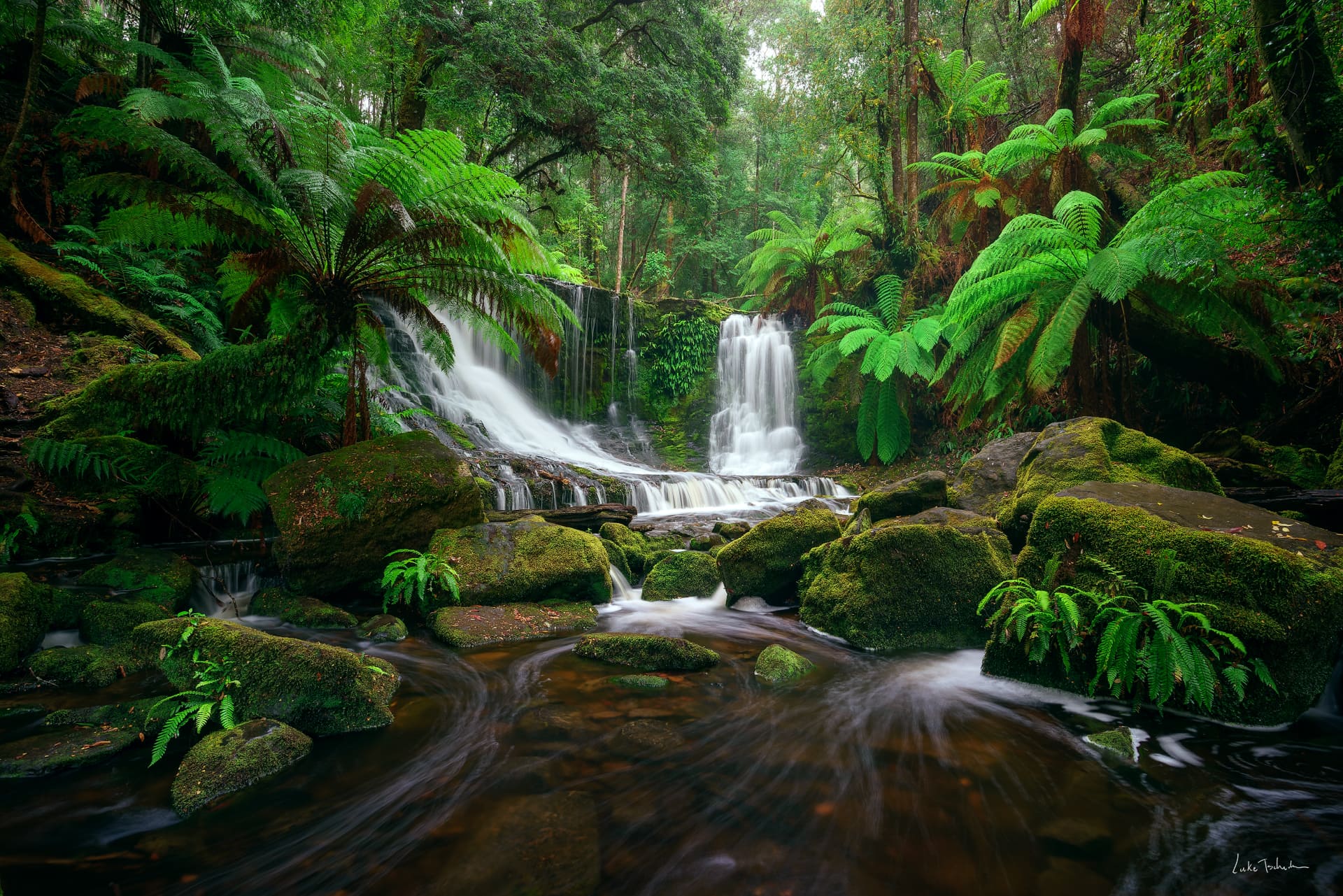
A photograph is a kind of portal. A portal into the world that I saw, the world that was, and maybe the world that still can be if we protect it. When I share an image, I'm trying to transfer a feeling. This is what it felt like to be alive in this moment. I want you to feel it too. And if seeing that beauty makes someone care about protecting these places, that's something meaningful. Tasmania has history here. A photograph of Rock Island Bend helped swing an election and save a river. Images can matter.
But there's a tension I can't ignore. The very act of sharing these places can lead people to want to see them for themselves. And sometimes that love can damage the thing we love. Places loved to death. It's a double-edged sword. Am I just commoditising this beauty? Using it as a vehicle for my own self-promotion? The goose that laid the golden egg. I think about this more than I'd like to admit.
I've been to these places, so who am I to say someone else can't go? But I don't have to tell them everything either. I don't have to give them a roadmap. I can share the beauty without handing over every detail of where and how. It's a responsibility I take seriously. You don't want to be part of destroying the beauty you're trying to celebrate.

Questions
Why do we chase beauty? I don't know if there's an answer. It's like asking why we love.
Maybe it's something evolutionary, some ancient wiring that draws us to places that once meant safety and survival. Maybe it's just dopamine. Maybe it's spiritual. Maybe it's all of those things at once.
What I do know is this: when you're out there, standing in front of something truly beautiful, the noise stops and the stillness takes over. You're there, fully present, and just like that, nothing else seems to matter. These are the moments.
I'm so freaking lucky I get to do this.

Here's to those that devote their lives to the endless chase of beauty.
Luke Tscharke
The optimists, the courageous, the brave.
Those that go out when the conditions are poor, the hours early, or the temperatures freezing.
Those that know the most beautiful light precedes the most inclement of weather, and the most interesting places are on the paths less trodden.
Those that understand that discomfort is the price for a meaningful experience, and recognise fear as a precursor for the expansion of life.
Never giving up, always searching, pushing through fatigue, anxiety and the naysayers.
At times the journey is lonely, hostile and unforgiving. However this inevitably gives way to excitement, joy, ecstasy.
It keeps the passion flowing like a wild river, stopping at nothing until it reaches the ocean.
To have a calling where one aims to be in the most beautiful places at the most beautiful times with the most beautiful light, simply to capture the moment to share with others; surely they are the most fortunate people on earth.